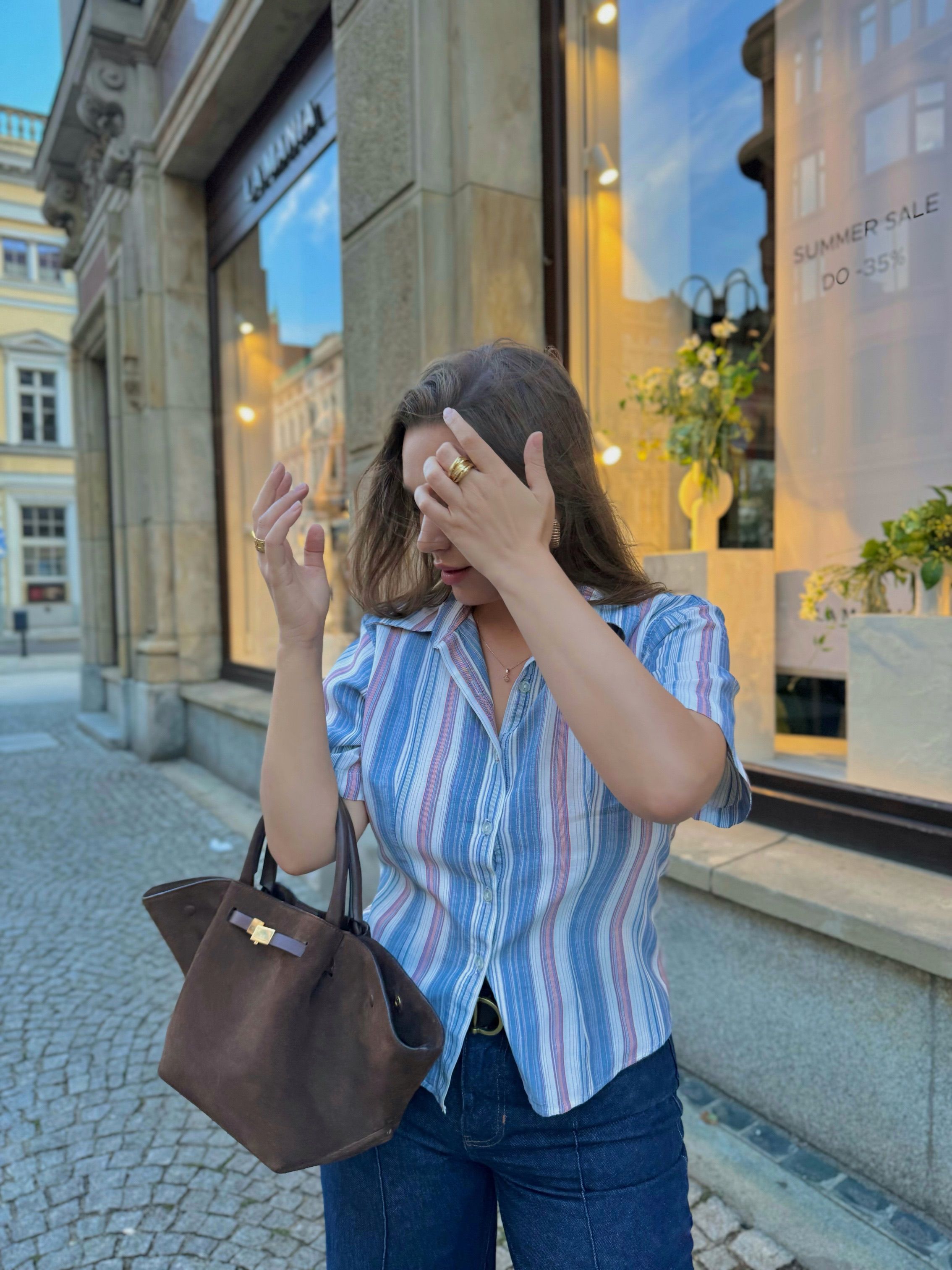
The Row Half Moon Bag: A Practical Buyer’s Guide
Most people meet the Half Moon sideways. It appears in a street-style shot, carried under an arm, with nothing about it announcing the label. There is no plaque, no monogram and no hardware calling out across the pavement, and that is precisely the point of the row as a maker of handbags. What follows is weeks of buyers working out whether a crescent-shaped shoulder bag with no visible branding earns its price. This guide resolves it with specifics: observed 2026 market prices, published dimensions, construction that can be verified by hand, and documented resale behaviour. There is no official price list at work here, as the brand publishes none. Every figure below was observable in the market during 2026.
A Crescent, No Statement
The Half Moon is named for its outline, and that outline does all the identifying work. The body describes a shallow arc that flattens against the ribs instead of swinging away, so it reads as part of the silhouette rather than an accessory hung onto it. The surface carries neither an exterior logo plaque nor a repeating monogram. Identification rests on proportion, the way the seams follow the curve, and a small discreet exterior stamp set low on the side where it blends in. A second stamp is placed inside. The restraint is the house language across every row bag, and it comes through clearly the row bags new top handle on this shape precisely because so little else is happening. If you want a bag that tells strangers what it cost, this is not the one.
The Dimensions Question, Frankly Answered
Most write-ups go wrong right here. The published dimensions for the Half Moon differ from source to source, and treating any one measurement as settled overstates what is known. The figure carrying most authority is the brand’s own: 8 x 13.5 x 2.5 inches. Take the shape seriously, because those numbers describe the bag more precisely than any adjective. It is wider than it is tall and only two and a half inches deep, making it a flat, long, close-to-the-body carrier rather than a bucket. A phone, cardholder, keys and a compact slot in; a hardback, a water bottle or a laptop sleeve do not. Treat any other quoted dimension as a range, and check the listing you are buying from.
Materials, Hardware and What Is Inside
A defined material palette shapes what The Row does, and it accounts for most of the price variation on any row bag. You get calfskin in smooth, matte grained, saddle and polished finishes, recurring lambskin and nappa, nappa usually as lining, and then suede, canvas, nylon, sisal and raffia to complete the range. Hardware is palladium-plated with a matte or brushed finish rather than a mirror shine, and should feel solid with a precise, quiet closing action. Linings are handled as materials in their own right rather than as branding surfaces, so inside you find nappa, lambskin, calfskin and cotton herringbone rather than logo jacquard. The Half Moon is one of the models for which the brand’s own product page states Made in Italy. Because origin is stated openly on some pages and left off others, being able to check it rather than assume it counts for something.
The Lining Is Not a Footnote
Buyers skim past lining descriptions, and with a bag this shallow that is a mistake. Inside a 2.5-inch-deep body the lining is in contact with everything you carry, so the material decides how the interior ages far more than in a deep tote. There is a real difference in wear: cotton herringbone, being woven, forgives keys and coins, while nappa is exceptionally soft and marks easily. Neither is a flaw — they just expect different habits from you. It also affects resale presentation, since interior condition is among the first things buyers inspect in listing photographs. Check which lining your variant carries before you commit, since the model runs in more than one construction.
What the Half Moon Was Priced At in 2026
The Half Moon was $1,390 on observed 2026 market pricing, which places it in the entry tier rather than close to the flagship end. At a stockist, a leather variant was observed at $1,690, which confirms the model runs in more than one material and at more than one price. Nothing unusual about that spread. The same silhouette in a richer hide costs meaningfully more, and across the line suede carries a consistent premium over calfskin. By way of perspective, the Soft Margaux 10 was observed at $3,650 and the Margaux Shoulder 12 at $4,900 over the same period. The Half Moon therefore lands at roughly a third of the flagship shoulder bag, with the same hardware finish and the same logo-free approach. Read them as observed market prices at a point in time, not as a published tariff.
Where It Sits Among the Entry-Tier Bags
Judging the Half Moon works best against the pieces occupying its price band. Roughly $590 to $1,500 in observed 2026 pricing defines that entry tier of the row bags, and the shapes inside it are genuinely varied. Some are pouches, some structured totes, some crossbodies, and they solve different problems despite sitting within a few hundred dollars of each other. Below, the table presents the observed figures so you can see the trade-offs directly. In daily use the deciding factor is capacity, not price. Begin at the right-hand column if the choice is between these.
| Style | Observed market price 2026 | Category | Practical note |
|---|---|---|---|
| Double Travel Wallet | $590 | Flat wallet | Only documents and cards |
| Boone Tote | $900 | Small tote | Lowest-cost tote entry point |
| Cecily Mini Tote | $950 | Mini tote | Compact with real structure |
| Sally | $1,000 | Small format | Minimal daily carry |
| 90’s Bag | $1,090 | Compact shoulder bag | Its closest style rival |
| N/S Park Crossbody | $1,290 | Crossbody | Hands-free carry |
| Half Moon | $1,390 | Curved shoulder | Flat 2.5 in depth |
| Idaho | $1,420 | Top handle | Structured counterpart |
What Resale Behaviour Says, and What It Does Not
The Half Moon has a documented secondary-market record, and it repays being read precisely. Rebag’s CLAIR 2025 report put the Half Moon shoulder at 106% value retention, which means observed resale prices tracked slightly above original retail. The same report put The Row at 97% retention brand-wide, which pushed it into the unicorn tier of 85% and above for the first time, behind only Telfar, Hermes and Goyard. To give the scale: 146% for the N/S Park Tote and 107% for the Margaux Tote in the same report. Every bit of that is observed market behaviour, not investment advice, and none of it promises anything about the future. The pattern is uneven too: canvas, nylon, sisal and seasonal-colour pieces routinely discount on resale, with appreciation concentrated in black and neutral calfskin in the signature silhouettes.
Who It Suits, and Who It Does Not
This bag suits a particular person and frustrates the rest. Its merits are flatness, quietness and where it sits on price relative to the rest of the range. Capacity is the limitation, and it is built into the shape rather than something packing skill can overcome. Anyone who carries a laptop, a notebook or a lunch will be reaching for something else inside a week. If you want a logo-free shoulder bag that melts into an outfit, very little else at this price does the same job. The list below sorts the decision quickly.
- Buy if all you carry daily is a phone, a cardholder and keys.
- Buy it if you want an entry point into row handbags and not the flagship outlay.
- Buy it if you favour a bag held close instead of swinging.
- Pass if you need a work, travel or laptop-sized bag.
- Skip it if visible branding matters to you, because there is none.
Care and Living With It
There is no publicly available brand-issued care protocol, so what makes sense is material-appropriate general guidance rather than invented rules. Overfilling is the first thing to avoid, and it matters more here because a shallow body distorts quickly when stuffed. Store it out of direct sunlight, heat and rain, in its dust bag and lightly stuffed so the crescent retains its shape. For calfskin and grained finishes, buff with a soft dry cloth and use neutral conditioner sparingly. Being softer, nappa and lambskin mark easily — dry cloth only, and no over-conditioning. If your variant is suede, treat it as the most fragile of them all — brush only, no cream, no wet wipes, no soap, and professional cleaning for real stains.
The Verdict, Plainly
The Half Moon is the most accessible way into the house’s shoulder-bag thinking, and it is honest about what it is. Silhouette, palladium hardware, an Italian-made construction and a lining treated as material rather than advertisement — that is what the price covers. Capacity is not what you are paying for, and it is worth admitting that when you try one. At an observed $1,390, with a leather variant seen at $1,690, it undercuts the flagship models by thousands while keeping the same design discipline. Browse listings marked the row for sale and it appears regularly on the major resale platforms, near or slightly above its original figure. Decide on one thing: whether the crescent suits how you actually carry things.